


There are moments in life with a clear before and after. For me, stumbling across the term Third Culture Kid (TCK) as an adult gave me a framework for the inner identity turmoil I never knew I harbored. It was one of those quiet holy sh*t moments where something I’d been carrying around without a name suddenly had one, and the before came into painful, vivid focus. In many ways, the TCK label brought more questions than answers, but ultimately facilitated the kind of relief that comes with recognition after decades of existing in constant translation.
However, I still held various identity constructs I already had names for. Immigrant. Multiracial woman. Mother. Everywhere I searched for belonging, I juggled parts of myself constantly, arranging and rearranging them depending on my audience with a practiced skill that would make a magician proud. Now you see me, now you don’t.
No matter the space and despite my best efforts, I would be left with pieces of myself that went unseen. I spend more time than I care to admit wondering if there’s a room somewhere that can hold all of me at once. I’m not sure there is, and quite frankly I’m not even sure it’s a problem to be solved.
But I do think it’s worth talking about.
First, Some Language
If you’re new to these terms, let’s get you caught up, because the labels themselves are worth understanding, even as we question how much they matter.
What Is a Third Culture Kid?
The term Third Culture Kid, or TCK, was developed by sociologist Ruth Hill Useem in the 1950s and later expanded by David Pollock and Ruth Van Reken in their landmark book Third Culture Kids: Growing Up Among Worlds. It describes a child who spends significant developmental years outside their parents’ home culture, typically due to a parent’s career, diplomacy, military service, missionary work, or international business. The “third culture” is the interstitial space that forms between the home culture and the host culture. It belongs to no single country but to anyone who’s lived the same kind of internationally mobile childhood.
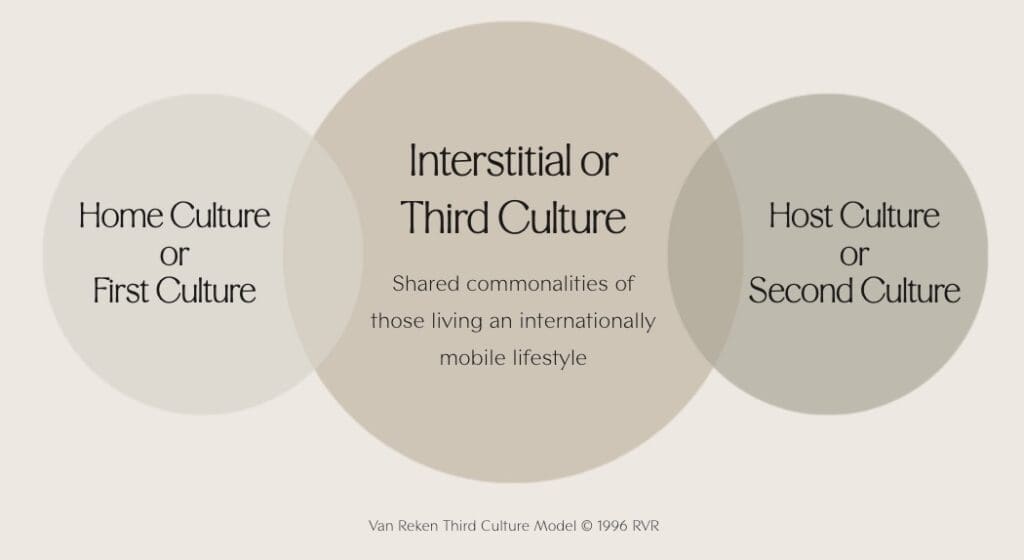
What makes this experience developmentally distinct is the timing. The cross-cultural complexity doesn’t happen to an already-formed person. It happens during identity formation, before a coherent sense of self has fully solidified. For many TCKs, myself included, the multiplicity doesn’t feel like disruption. It feels like the original condition. There is no singular before.
This is partly why it can take so long to name. There’s no clear moment of loss to point to. The experience just… is.
What Is a Cross-Cultural Kid?
CCK, or Cross-Cultural Kid, is the broader umbrella, also from Pollock and Van Reken’s framework. Every TCK is a CCK, but the category is wider, capturing anyone who grew up navigating significant cross-cultural complexity for any reason.
That includes children of immigrants, who hold two worlds at once without ever moving themselves. Multiracial and biracial individuals, navigating more than one racial and cultural identity simultaneously. International adoptees, carrying the culture of their birth alongside the culture of the family who raised them. And domestic TCKs, kids who moved constantly within their own country, often for a parent’s career, experiencing the same cycle of uprooting without ever crossing a border. The shifts are smaller. The developmental experience is remarkably similar.

Where Does the Immigrant Experience Fit In?
And then there’s the immigrant. Someone who arrives with a more formed identity, a clearer before, a grief that has a more legible object. The self existed in one place, and now constructs (and sometimes reconstructs) itself in another. The tension between those two selves is real and ongoing and doesn’t resolve simply because time passes or assimilation deepens.
If there’s one thing I’ve realized through my own story, it’s that these categories bleed into each other constantly. The TCK who settles in a country that was never home is also, functionally, an immigrant. A child of immigrants who never moved navigates cross-cultural complexity from birth. A multiracial person who never left their hometown holds more than one world inside them regardless.
The labels are useful. They’re also, inevitably, insufficient.
An Imposter in Every Room
Here’s the thing about existing between categories: you can end up feeling like an imposter in all of them.
My English is functionally perfect. No one suspects it isn’t my first language, that I speak another language fluently, that I’m an immigrant, or that I grew up somewhere else entirely. I move through the world with a kind of cultural invisibility that I know is a privilege in so many ways. It’s also meant that significant parts of my experience went unseen, not necessarily because people were unkind, but because nothing on the surface invited the question.
In TCK spaces, I sometimes feel like I don’t qualify. Like there’s an unspoken hierarchy of mobility, more countries, more moves, earlier uprooting, and my particular version of the experience doesn’t quite meet the threshold. The TCK in me is real. And yet..
In immigrant spaces, the survival grief that anchors so much of the shared experience isn’t quite mine either. My leaving was chosen, or close enough to chosen that the distinction matters. The specific weight of that kind of displacement, the forced departure, the inability to return, the particular grief of a home that was taken rather than left, I hold that with deep respect, and I don’t claim it as my own.
So I drift. Recognized in pieces, but not in full. Belonging to the edges of multiple communities without fully inhabiting any of them.
I’ve come to think this is more common than anyone admits. The imposter syndrome of the cross-cultural experience is its own form of fragmentation. And it’s exhausting in a way that’s hard to explain to someone who’s always known, simply and without question, where they’re from.

The Belonging Gap
What I’ve noticed in myself and in the people I work with is a persistent and often exhausting cycle: the search for a space where all of it fits. Where you don’t have to leave part of yourself at the door. Where the full complexity of your background isn’t just tolerated but genuinely understood.
Sometimes you find glimpses of it. A conversation with someone who’s lived between worlds in a similar way. A community that holds more nuance than most. A relationship where you don’t have to translate yourself or your history.
The One Space That Cuts Through
So far, the one place I’ve found the most consistent common ground is parenthood. There’s something about the universal, leveling experience of becoming a parent that cuts through cultural complexity in a way few other things do. To me, it has felt like its own kind of third culture. A space where the label recedes and the experience itself becomes the common ground. That’s worth its own conversation, but I mention it here because it’s taught me that belonging, when it does arrive, rarely looks the way you expected it to.
Making Peace With Partial Belonging
Most of the time, though, the search continues. I recently met with a longtime TCK friend of mine who gently reminded me of the reality that there may not be a single space that holds all of me at once. That the belonging I’m looking for may always be partial, and that I may always be slightly outside, even in the rooms that were made for people like me.
I don’t say that to be bleak. I say it because naming it honestly, without dressing it up as resilience or reframing it as richness, is itself a form of relief.
If You’re Not Sure Which Label Fits
You don’t have to be certain. You don’t have to have the right credentials for your own experience.
If you grew up between cultures and the TCK framework resonates but doesn’t fully fit, you might be a CCK. If you immigrated and carry the particular grief of a self that formed somewhere else, that’s its own real and valid experience. If you’re multiracial, or the child of immigrants, or someone who moved constantly within one country and never quite felt at home anywhere, there’s language for that too, even if it hasn’t found you yet.
And if you exist somewhere between all of these categories, belonging fully to none of them, welcome. That’s a very real place to be. It doesn’t have a perfect name, but it’s not nothing, and you’re not alone in it.
The belonging-seeking is exhausting. The belonging-deficit is real. And neither of those things means something’s wrong with you
So, Does the Label Matter?
Yes, if it helps you name a part of yourself that’s been waiting for language. If there’s one thing I’ve learned, that’s not nothing. Recognition matters.
But here’s the more honest answer: we exist in parts, and the complexity of human existence is that we will likely never be fully understood, seen, or recognized in every space we find ourselves in. Even in the simplest of circumstances, multiplicity is the rule, not the exception. There isn’t a label, a community, or a room built specifically enough to hold every piece of you at once.
Maybe there’s beauty in letting that reality coexist with the occasional place we do experience belonging, even if only for a moment. Maybe the label was never meant to be the whole answer. Just a place to start.
References
Pollock, D. C., & Van Reken, R. E. (2009). Third Culture Kids: Growing Up Among Worlds (3rd ed.). Nicholas Brealey Publishing.
Useem, R. H., & Cottrell, A. B. (1996). Adult third culture kids. In C. D. Smith (Ed.), Strangers at Home. Aletheia Publications.
Fail, H., Thompson, J., & Walker, G. (2004). Belonging, identity and Third Culture Kids. Journal of Research in International Education.
Schwartz, S. J., et al. (2010). Identity around the world: An introduction. New Directions for Child and Adolescent Development.


