


I have tried a lot of frameworks over the years. Some looked compelling on paper. Some made sense intellectually. But when I brought them into the room, something felt effortful in a way that good therapy shouldn’t, like I was working from a script rather than from myself. If I couldn’t find my own experience somewhere inside a framework, how could the translation to actual clinical work be anything but hollow?
IFS was different. And the reason is almost embarrassingly simple: I didn’t have to find myself in it. I was already there.
You already know this
At some point in your life you have said something like:
A part of me really wanted to say yes, but a part of me just wasn’t sure. Part of me knows I should let it go. Another part of me can’t. There’s a part of me that’s excited and a part of me that’s terrified.
That’s not a figure of speech. That’s an accurate description of what is actually happening inside you, and is the foundation of Internal Family Systems, or IFS.
The moment I heard that in a training, something clicked. I started hearing it everywhere, in sessions, in conversations, in my own internal monologue. The language was already there. IFS just gave it a grammar.
So what is a part, exactly?
Internal Family Systems, or IFS, is a therapeutic framework developed by psychologist Dr. Richard Schwartz in the 1980s. What he noticed, and what decades of clinical work have since supported, is that the mind isn’t a single, unified thing. We’re a system of parts, each with its own perspective, history, and way of trying to protect us. It sounds simple. It also happens to be one of the most useful maps of human inner life I’ve ever encountered.
Think of your parts as aspects of your personality. Sub-personalities, each with their own distinct desires, fears, and ways of moving through the world. They developed over time, shaped by your experiences and the environments you had to navigate. And they are all, in their own sometimes destructive way, trying to help you.
A client once offered me an analogy that has stayed with me, and that I’ve since shared with others, because it lands every time.
Meet your team
Your parts are like a sports team. All the players, on and off the court. And the Self, the calm, curious, compassionate core that IFS works to restore, is the coach.
Some players are incredible. The MVP who wants the ball every possession, shoots without passing, carries the team night after night. Exhausted, but convinced the team can’t win without them. Some teams have several players like this, all competing for the ball at once. Then there are the talented players on the bench who never seem to get any playing time.
And sometimes the team doesn’t trust the coach. They’ve been running their own system for so long that they tune the coaching out entirely.
IFS work is the process of learning to be the coach again. Not to cut any players, not to bench the MVP permanently, but to run the team in a way where everyone’s strengths are used. No one is carrying more than their share, and the whole system functions with a little more balance and trust.
Every player is good. Every part of you is necessary. The goal is never elimination. It’s collaboration, with you, the coach, actually leading.
The players on your team
Not all parts play the same role. In IFS, there are three types worth knowing.
Managers are your starters. They show up early, run the plays, and keep everything organized. They’re the parts that plan ahead, maintain control, and work hard to make sure nothing goes sideways. Managers are often the first parts you meet in therapy, articulate, capable, holding it together. They’re not the problem. They’re often just very, very tired and overfunctioning in some way.
Firefighters come off the bench in a crisis. When something feels overwhelming or threatening, firefighters react fast, often impulsively, to put out the emotional fire as quickly as possible. They don’t always make the most measured decisions, but that’s not their job. Their job is to stop the pain, right now, by whatever means necessary. Overeating, numbing out, picking a fight, disappearing into your phone for three hours, these are often firefighters doing what they were trained to do.
Exiles are the most vulnerable player on the team, often the one who got hurt early and never fully recovered. They’re kept off the court not out of cruelty, but out of protection. If they play, they might get hurt again, or their pain might cost the whole team the game. So the managers and firefighters organize much of what they do around one unspoken priority: keeping that player on the bench.
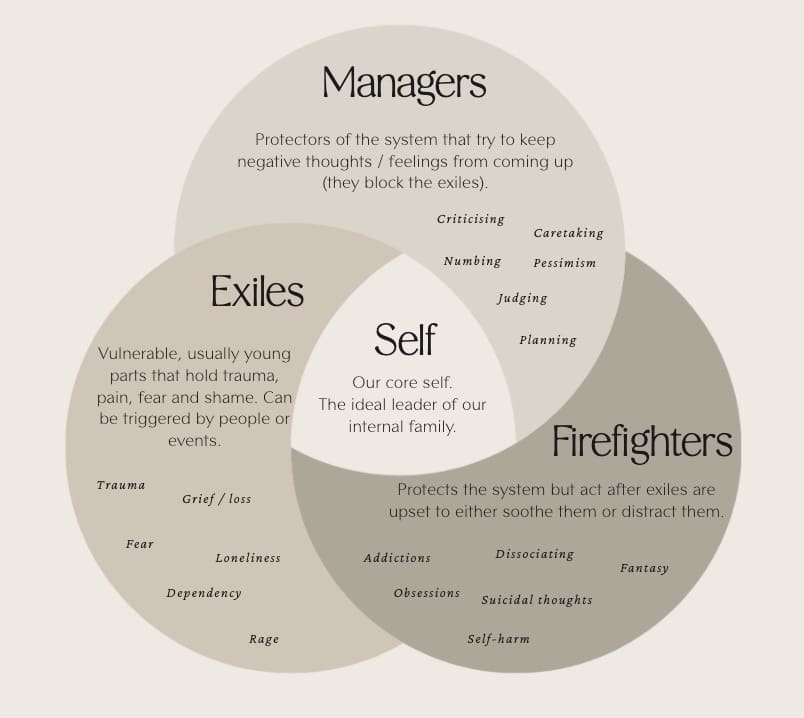
Here’s what I want you to hear about all three: none of them are the enemy. Every single one developed for a reason. The goal of IFS isn’t to cut any of them. It’s to help the coach, your Self, lead in a way where the team feels much more balanced.
What happens when it works
Things slow down. The part of you that usually narrates, that running inner commentary that keeps you at a slight remove from your own experience, begins to step back. Underneath it, something more specific comes into focus. Something tender. Sometimes unsurprisingly young. Sometimes carrying more pain than you realized.
What I notice in those moments is that clients begin to understand that they are the ones with the capacity to create the change they’ve been looking for. Not me. Not the framework. Them. The restored sense of possibility is almost palpable. It is one of the most hopeful things I get to witness in this work and why I love what I do.
Why this matters for the people I work with
I work with individuals who have had to be many things to many people. TCKs who learned to become whoever the room needed, new mothers navigating an identity that no longer quite fits, immigrants holding two selves across two worlds, people doing deep healing work who have spent years feeling like their inner life is too complicated to make sense of.
For those people, IFS offers something specific that I haven’t found as readily in other frameworks. It hands the power of agency and change back to them. Rather than positioning the therapist as the expert who decodes your experience, IFS works to restore your own access to your own inner wisdom. The coach was always there. We’re just clearing the way for them to lead again.
On Curiosity and Multiplicity
IFS essentially creates enough distance from the difficult parts that people can get curious about them rather than drowning in them. Instead of being the anger, or the shame, or the shutting down, you can begin to notice it. Observe it. Ask it what it needs. That small shift, from blending with a part to witnessing it, can change everything.
And perhaps most importantly for the people I work with: it welcomes multiplicity. It doesn’t ask you to be one coherent, consistent thing. It says: of course you are made of many parts. Of course they don’t always agree. Of course some of them were shaped by experiences that no longer reflect who you are or where you are now. That is not a disorder. That is being human. And all of those parts, every single one, are welcome here.
References
Schwartz, R. C. (1995). Internal Family Systems Therapy. Guilford Press.
Schwartz, R. C., & Sweezy, M. (2020). Internal Family Systems Therapy (2nd ed.). Guilford Press.
Anderson, F. G., Sweezy, M., & Schwartz, R. C. (2017). Internal Family Systems Skills Training Manual. PESI Publishing.


